
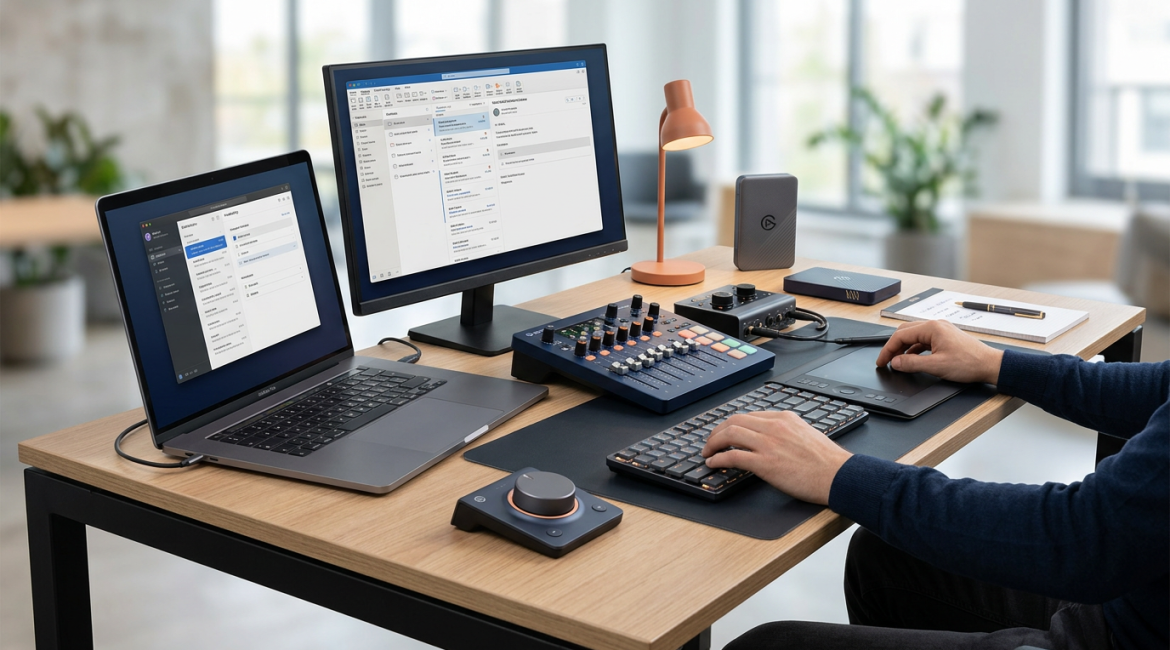
For the better part of two decades, the narrative in music production was clear: hardware was a relic of the past. The “In-The-Box” (ITB) revolution promised that anything a thousand-dollar rack unit could do, a twenty-dollar plugin could do better, faster, and without the cable clutter. Studios began to look more like office cubicles, centered around a single high-powered laptop and a MIDI controller.
But a funny thing happened on the way to total digitalization. Producers started missing the noise. They missed the unpredictability. They missed the physical act of turning a knob and feeling the filter sweep in their fingertips. Today, we are witnessing a massive “Hardware Comeback,” but it isn’t a rejection of digital technology. Instead, it’s the birth of the hybrid workflow—a sophisticated marriage of analog drum machines, synthesizers, and outboard gear with the surgical precision of the modern DAW (Digital Audio Workstation).
The Sterile Trap: Why 100% Digital Can Feel Flat
There is no denying the power of modern VSTs (Virtual Studio Technology). They are clean, they are perfect, and they offer infinite recall. However, that perfection is exactly where the problem lies for many creators. When every kick drum is mathematically perfect and every synth wave is a flawless calculation, the music can begin to feel “sterile.”
Digital audio exists in a world of ones and zeros. Analog hardware exists in a world of electricity, heat, and slight imperfection. When you run a signal through an analog drum machine like a Roland TR-8S or a boutique Moog synthesizer, you aren’t just playing a sound; you are interacting with physical components. The slight timing fluctuations (often called “jitter”) and the harmonic distortion caused by pushing a vacuum tube or a transistor create a “vibe” that software often struggles to emulate authentically.
The Power of “Happy Accidents”
One of the biggest drivers behind the hybrid movement is the pursuit of the “happy accident.” In a purely digital environment, you generally have to intend to do something before it happens. You click a menu, you drag a slider, you load a preset.
With hardware, the interaction is tactile. You might bump a slider while reaching for a knob, or two oscillators might drift into a beautiful, phasing dissonance that you could never have planned. These moments of unpredictability are the sparks that often lead to a track’s most iconic hook. By bringing hardware back into the box, producers are reintroducing the human element into their electronic compositions.
Tactile Control: Moving Beyond the Mouse
Let’s be honest: clicking and dragging a mouse to adjust a frequency cutoff is not an inspiring experience. It feels like filing taxes. Music is an emotional, physical medium, and hardware controllers or standalone instruments provide a level of expression that a mouse simply cannot match.
- Muscle Memory: Experienced producers develop a physical relationship with their gear. They know exactly how far to turn a knob to get the desired grit without even looking at the screen.
- Performance-Oriented Production: Using a drum machine like an MPC or a Maschine allows you to “perform” your drum patterns. The velocity-sensitive pads capture the swing and the “soul” of a human performance, which is much harder to program manually on a piano roll.
- Focus: Turning off the computer monitor and focusing solely on a piece of hardware can break “screen fatigue” and help a producer tap into a different part of their creative brain.
The Hybrid Bridge: Best of Both Worlds
The modern hardware comeback isn’t about going back to tape reels and massive mixing desks. It’s about integration. Technology has reached a point where the “bridge” between hardware and software is seamless. Features like Overbridge (by Elektron) or advanced USB-audio integration allow producers to plug a single cable into their laptop and treat their high-end analog drum machine as if it were a plugin inside their DAW.
This hybrid setup offers a workflow that is arguably superior to either 100% analog or 100% digital:
1. Analog Sound, Digital Convenience
You get the rich, saturated tones of real analog circuitry, but you can still use your DAW’s automation to control parameters. You can record the audio directly into your project, keeping the grit while maintaining the ability to edit, chop, and rearrange with digital speed.
2. Offloading CPU Power
Modern plugins are incredibly CPU-intensive. By using external hardware—like a dedicated hardware synth or an outboard compressor—you are essentially “outsourcing” the processing power. This allows your computer to run more smoothly, reducing latency and crashes during complex sessions.
3. Unique Sonic Signature
In an era where everyone has access to the same Splice samples and the same Serum presets, sounding “different” is the ultimate competitive advantage. A hybrid setup allows you to create custom sounds that are unique to your specific gear and how you’ve patched it. It’s much harder for someone to replicate your “sound” if it involves a specific piece of hardware driven through a specific analog preamp.
The Psychology of the “Box”
There is also a psychological component to the hardware comeback. Having a physical “instrument” in the room changes the way you perceive your workspace. A studio filled with tactile gear feels like a laboratory of sound; a room with just a laptop feels like an office. For many businesses in the creative sector, from jingle houses to film scoring suites, the presence of hardware acts as a visual and functional inspiration for both the creator and the client.
Conclusion: The Future is Hybrid
The “Hardware Comeback” isn’t a trend driven by nostalgia; it’s a course correction. After years of chasing digital perfection, the industry has realized that the most compelling music lives in the space between the digital and the physical. By combining the infinite flexibility of the “box” with the soul and tactile joy of hardware, producers are finding a more fulfilling—and better sounding—way to work.
Whether you are a hobbyist looking to spice up your tracks or a professional studio aiming to stand out, the hybrid workflow is the gold standard for the modern era. It’s time to take the best of the past and plug it into the future.