
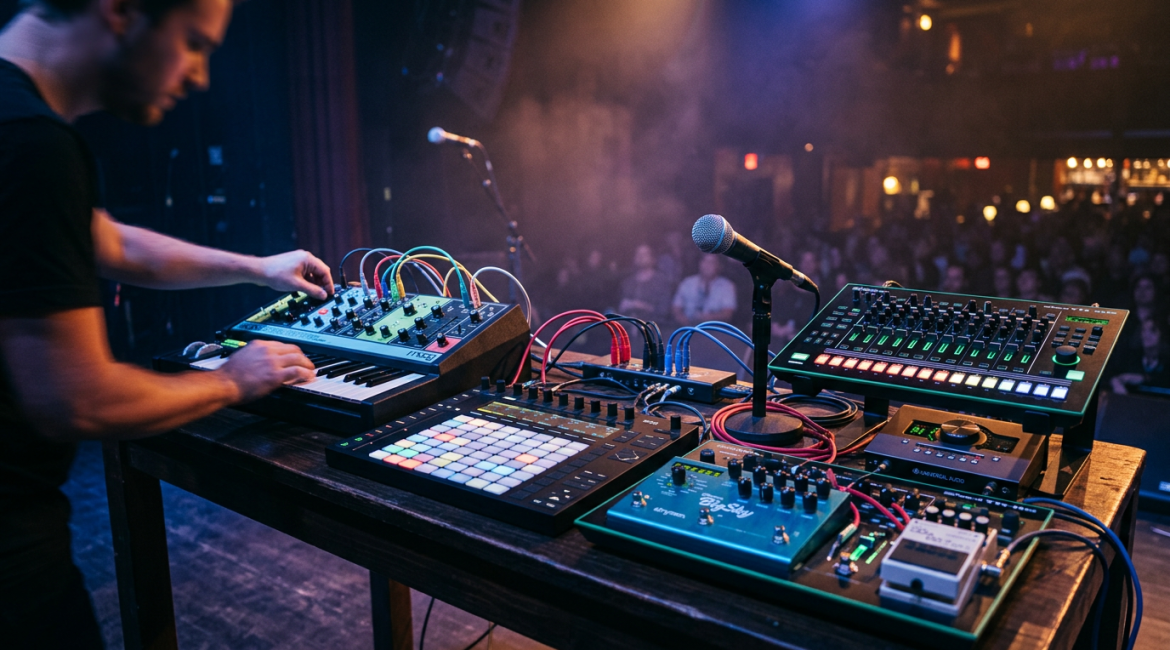
Building a hybrid live set involves integrating traditional DJ software or hardware with live performance tools like MIDI controllers, analog synthesizers, and drum pads. This setup allows performers to transition from simply blending two tracks to creating original arrangements, triggering live samples, and performing melodic sequences in real-time during a professional electronic music performance.
What are the essential components of a hybrid live set?
A hybrid live set typically requires a central hub, such as Ableton Live or Pioneer’s rekordbox, combined with an audio interface and MIDI controllers. You need a mix of tactile hardware, including drum pads for percussion, keyboard controllers for melodies, and a multi-channel mixer to blend digital tracks with live hardware audio signals.
To build a versatile rig, consider these core elements:
- The Master Clock: A software or hardware sequencer that keeps all devices synced at the same BPM.
- Tactile Controllers: Devices like the Akai APC40 or Novation Launchpad for triggering loops.
- Sound Generators: Compact hardware synths like the Korg Volca series or Roland Boutique line.
- Audio Interface: A device with at least four inputs to bring external hardware audio into your recording or mixing software.
How do you transition from standard DJing to a hybrid performance?
The transition begins by introducing a single piece of live hardware, such as a drum machine, synced to your existing DJ software via MIDI clock or Ableton Link. Performers move away from playing completed tracks toward playing “stems,” which are broken-down versions of songs separated into drums, bass, and melodic parts.
Instead of the traditional “Track A to Track B” transition, hybrid performers use loops. You might keep the kick drum from a digital track running while you manually play a new lead melody on a synthesizer. This method allows for infinite transitions where the music never truly stops or switches; it evolves through layers. Start by mastering one live element for 15 minutes of your set before attempting to perform an entire hour-long hybrid show.
Which MIDI controllers are best for hybrid DJ sets?
The best MIDI controllers for hybrid sets offer a mix of faders, knobs, and velocity-sensitive pads to handle both volume mixing and percussive performance. The Akai MPC Studio and Native Instruments Maschine are industry standards for drum triggering, while the Arturia KeyStep provides a compact footprint for playing synth lines.
When selecting gear, prioritize portability and reliability. A standard 10-input audio interface like the Focusrite Scarlett 18i8 provides enough headroom to grow your setup. For clip launching, the Ableton Push 3 is often cited as the most comprehensive tool because it eliminates the need to look at a laptop screen, allowing the performer to engage more directly with the audience.
How do you sync hardware synths with DJ software?
Syncing hardware with software is achieved using MIDI Clock or Ableton Link, which sends a tempo signal from the “master” device to all “slave” devices. This connection ensures that every delay, arpeggio, and drum beat stays perfectly aligned with the grid of the digital tracks being played.
Most modern DJ mixers, such as the Pioneer DJM-V10 or the Allen & Heath Xone:96, feature dedicated MIDI Out ports or built-in soundcards designed for this exact purpose. To avoid “latency” (audio delay), set your software buffer size to 128 or 256 samples. Testing the sync stability for at least 30 minutes before a show is a critical step in preventing tempo drift during a live performance.
What are the benefits of using drum pads in a live set?
Drum pads allow a performer to add “human feel” and rhythmic variation that static digital files cannot replicate. By finger-drumming live over a playing track, you can introduce fills, builds, and energy shifts that respond directly to the crowd’s reaction.
Using drum pads also transforms the visual aspect of a performance. Audiences often find it more engaging to see a performer physically hitting pads to create a sound rather than just turning a filter knob. Integrating a tool like the Roland SPD-SX or a simple MIDI pad controller enables you to trigger one-shot samples, such as vocal stabs or custom risers, which makes your version of a track unique compared to the original studio recording.
Frequently asked questions
What is the difference between a DJ set and a hybrid live set?
A DJ set involves playing pre-recorded tracks and mixing them together using EQ and faders. A hybrid live set combines this traditional mixing with live elements, such as playing synthesizers, triggering drum samples, and manipulating individual song stems in real-time to create a unique version of the music.
Do I need a powerful laptop for a hybrid live set?
Yes, a hybrid set requires a laptop with at least 16GB of RAM and a modern multi-core processor to handle the simultaneous processing of DJ software, live MIDI data, and multiple audio inputs. Using an SSD (Solid State Drive) is also essential to ensure that samples and tracks load instantly without lag.
Can I use hybrid setups with vinyl records?
Hybrid setups work exceptionally well with vinyl when using DVS (Digital Vinyl System) technology or a mixer with multiple channels. You can play a traditional vinyl record on one channel while syncing a drum machine to the tempo of the record manually or through software that detects the incoming BPM of the turntable.
How do I prevent my equipment from crashing during a show?
To prevent crashes, disable Wi-Fi and Bluetooth on your performance laptop, use high-quality shielded USB cables, and always use a powered USB hub for your controllers. It is also recommended to have a “fail-safe” audio source, such as a backup media player, ready to play if the software requires a restart.
Is it expensive to start a hybrid live set?
Starting a hybrid set can cost as little as $200 if you add a basic MIDI pad controller to your existing laptop setup. However, a professional-grade rig including a high-end audio interface, analog synthesizers, and dedicated clip-launching hardware typically ranges from $1,500 to $5,000 depending on the brands and complexity chosen.